You may know the Splash Mountain ride at the Disney parks or the famous song "Zip-A-Dee-Doo-Dah" but can you name the movie it comes from?
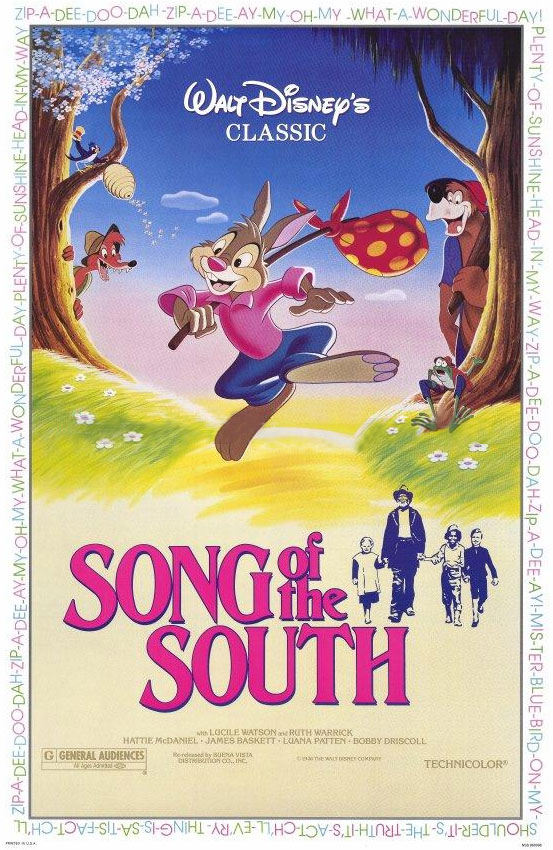
Song of the South was released in 1946 and was the first film Walt Disney attempted mixing animation with live-action. In the early 80's, they would allowed the particular song to be shown on the Disney Channel as a music video but not show the entire movie. I love seeing it, it was so beautiful but I wonder what it was.
Wikipedia: Walt Disney had long wanted to make a film based on the Uncle Remus storybook, but it wasn't until the mid-1940s that he had found a way to give the stories an adequate film equivalent, in scope and fidelity. "I always felt that Uncle Remus should be played by a living person," Disney is quoted as saying, "as should also the young boy to whom Harris' old Negro philosopher relates his vivid stories of the Briar Patch."
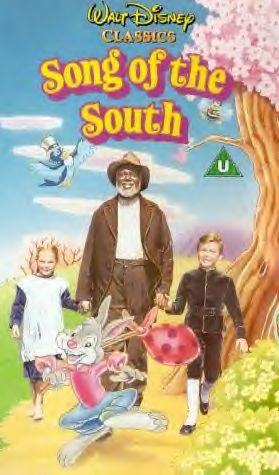 The latest release on VHS was in 1986. The above picture is of the UK 2000 VHS release. It omits the other young boy from the poster we can see on the above reissue poster from 86'. Disney has avoided releasing any more releases or even on DVD. To this day, when the corporation is asked why there aren't any new release plans, they still think it is a sensitive subject... again as mentioned in the past few posts about racist cartoons in this contemporary world. The Zip-A-Dee-Doo-Dah and Br'er Rabbit tricking Br'er Bear into the trap scenes are found in the 1950 special "One Hour in Wonderland" included on the 2004 two-disc release of Alice in Wonderland. The famous song even won an Oscar in 1947.
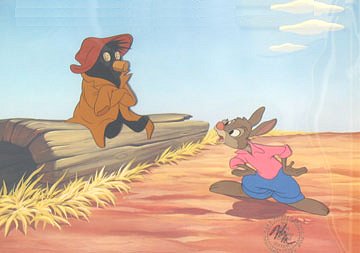 Also controversial was Tar Baby, which conveniently doesn't have a picture in Wikipedia. It was just tar and used to trap Br'er Rabbit and was changed to a honey pot for the Splash Mountain ride to avoid you know what.
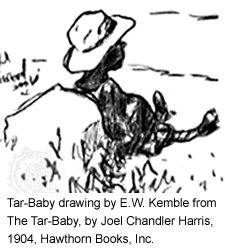 This drawing of him for a book based on the stories has him look more and more like a person. A "tar baby" in this case was metaphorical for any "sticky situation" that can only be aggravated by efforts to solve it. The term most commonly has negative connotation as a derogatory term and in some cases refers to little African-American girls.
 Tony Snow used the term ("I don't want to hug the tar baby of trying to comment on the program") in one of his first briefings as White House Press Secretary. Snow's use of the term which I guess is much like the firstly mentioned 'sticky situation' was much lampooned in the media.
 The movie was deliciously parodied in SNL as Uncle Jemima's malt liquor with Tracy Morgan. Where it was alluded to that he only saw the animated creatures because of the liquor y queestaba casado con la tal Aunt Jemima. Ay Dios. It was sorta dark tone to it which was more haunting on late night broadcast. Only when bright bright cartoons and live-action can be a good kind of creepy nostalgia. But even though they sorta avoid it exists, it doesn't stop them making money off it from the rollercoaster rides.